Bloodlines of Excellence: Why Provenance Defines the World's Finest Ornamental Fish
1. Introduction: The Invisible Architecture of Value Imagine standing before two seemingly identical ornamental fish. To the untrained eye, b...
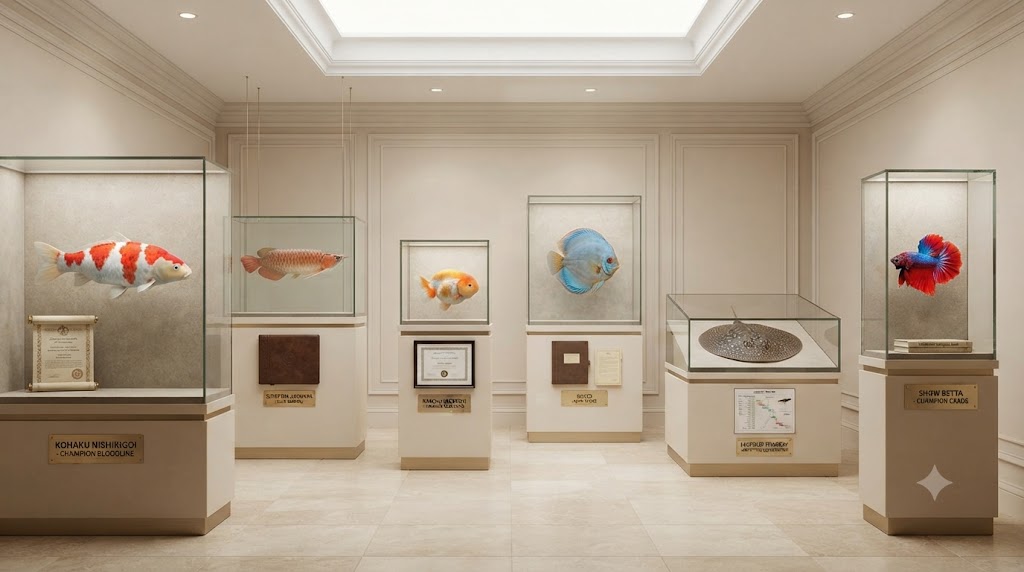
1. Introduction: The Invisible Architecture of Value
Imagine standing before two seemingly identical ornamental fish. To the untrained eye, both possess vibrant coloration, graceful movement, and an undeniable aesthetic appeal. Yet, in the rarefied world of luxury aquaculture, one might be valued at a few hundred dollars, while the other commands a price equivalent to a fine sports car or a rare vintage timepiece. The difference between these two specimens is profound, yet invisible. It is a distinction built not merely on appearance, but on the invisible architecture of genetics, lineage, and documented history.
In the pursuit of collecting the world's finest ornamental fish—whether they be the majestic Super Red Arowana, the sculptural Nishikigoi, or the ethereal Freshwater Stingray—beauty is merely the prerequisite. True value is dictated by provenance. In an era where mass breeding has commodified many aquatic species, the discerning collector seeks out specimens that offer something far rarer: a documented legacy of excellence.
This pursuit of perfection is a journey that transcends aquatic husbandry and enters the realm of living fine art. Just as a connoisseur of high horology values the heritage of a Patek Philippe, or an art collector seeks the verified brushstrokes of an old master, the elite fish collector understands that a fish without a lineage is a masterpiece without a signature. This guide delves into the intricate world of bloodlines, breeder reputations, and the paramount importance of provenance in defining the ultimate value of premium ornamental fish.
"A truly elite ornamental fish is not simply bred; it is sculpted over generations by masters who view genetics as their clay."
2. What Is a Bloodline? The Science of Sculpting Life
To understand the premium ornamental fish market, one must first understand the concept of a bloodline. A bloodline is far more than a family tree; it is a proprietary genetic recipe meticulously refined over decades through rigorous selective breeding. It is the physical manifestation of a master breeder's philosophy.
Selective Breeding and Genetic Stability
The creation of a premier bloodline requires an almost unfathomable level of patience. Breeders select only a fraction of a percent of their fry—sometimes keeping only a few dozen from a hatch of tens of thousands—based on microscopic indicators of future potential. Over multiple generations, this intense selection process locks in desirable traits and eliminates genetic weaknesses, creating a stable, predictable lineage.
Inherited Characteristics Across Species
The impact of a strong bloodline manifests uniquely across different species of ornamental fish:
- Nishikigoi: In Koi, bloodlines dictate the thickness and luminosity of the skin (tsuya), the depth and edge sharpness of the colors (kiwa and sashi), and the fish's ability to develop a massive, torpedo-like frame (jumbo genetics) without losing its elegant proportions.
- Super Red Arowana: For the Asian Arowana, elite lineage guarantees the intensity of the red pigmentation, ensuring it deepens into a rich, blood-red hue as the fish matures, rather than fading to an uninspiring orange. It also dictates body shape, scale shine, and the dramatic, sweeping curvature of the pectoral fins.
- Freshwater Stingray (e.g., Black Diamond): Bloodline determines the starkness of the black base and the density, clarity, and perfection of the white eclipse spotting, traits that are fiercely protected by top breeders.
- Discus: In Symphysodon breeding, lineage guarantees a perfectly circular, high-bodied profile and solid, neon-bright coloration without the "peppering" or irregular striations that plague lesser strains.
- Ranchu and Betta: For the sculptural Ranchu goldfish and the ornate Betta, genetics dictate the precise angle of the back curve, the volume of the headgrowth (wen), and the structural integrity of the elaborate fin rays, ensuring they do not collapse under their own weight.
A fish from an unverified source may look promising as a juvenile, but without a stable bloodline, its development is a gamble. A fish from a proven bloodline is a promise—a promise that the specimen will mature gracefully, retaining and enhancing its beauty over the course of its life.
3. The World's Most Respected Breeders: Artisans of the Aquatic Realm
In the luxury fish trade, the name of the breeder carries the same weight as an artist's signature on a canvas. Certain breeding farms have achieved a mythic status, their names synonymous with uncompromising quality and consistent Grand Champion victories.
Nowhere is this more evident than in the Nishikigoi epicenter of Niigata and Hiroshima, Japan, where family dynasties have guarded their genetic secrets for over a century.
- Dainichi Koi Farm: Arguably the most famous name in the Koi world, Dainichi is revered for producing Kohaku and Showa with formidable, muscular bodies and deeply layered, lustrous skin. A Dainichi certificate is an undisputed mark of prestige among global collectors.
- Momotaro Koi Farm: Famous for their revolutionary integration of wild magoi (black carp) genetics, Momotaro has redefined the modern standard for size. Their fish are celebrated for their explosive growth rates and massive, commanding presence, regularly breaking the one-meter barrier.
- Isa Koi Farm: When collectors speak of the Showa variety—a dynamic pattern of red, white, and black—they speak of Isa. Isa Showa are legendary for their powerful, ink-black markings (sumi) that develop with profound intensity as the fish ages.
- Omosako Koi Farm: The undisputed masters of the Shiro Utsuri (black and white koi). Omosako has achieved a level of contrast that seems almost digitally altered, combining snow-white skin with deep, lacquer-like black patterns.
- Torazo Koi Farm: A heritage name that traces its roots back generations, Torazo is celebrated for producing Kohaku of exquisite refinement, focusing on traditional, elegant patterns and immaculate skin quality.
Beyond Japan, similar reverence is afforded to elite Arowana farms in Indonesia and Malaysia, and specialized Discus breeders in Thailand and Germany. These artisans do not chase volume; they chase perfection. Their reputations are built on decades of consistency, making their certified offspring the most sought-after investments in the hobby.
4. Why Provenance Matters: The Currency of Authenticity
As the market for premium ornamental fish has grown, so too has the importance of verifiable provenance. When collectors invest thousands—or hundreds of thousands—of dollars into a living creature, a handshake and a visual inspection are no longer sufficient.
The Documentation of Excellence
True premium fish are accompanied by a meticulous paper trail. Breeder certificates act as the fish’s passport and birth certificate. These documents are often ornate, watermarked, and signed by the master breeder, detailing the fish’s variety, hatch year, exact bloodline lineage, and often featuring a photograph of the specific specimen taken at the farm.
For highly regulated and deeply valued species like the Asian Arowana, provenance is further secured through technology. Passive Integrated Transponder (PIT) microchips are painlessly implanted into the fish, providing a unique alphanumeric code that irrevocably links the living specimen to its CITES (Convention on International Trade in Endangered Species) documentation and breeder certificate. This eliminates the possibility of forgery and guarantees the fish’s origin and legality.
Comparing Aquatic Art to Traditional Luxury
The necessity of provenance in ornamental fish is directly analogous to other high-end asset classes. A Rolex Daytona without its original box and papers sees a significant reduction in market value, just as a painting attributed to Monet cannot be sold at Sotheby’s without rigorous historical authentication. In the same vein, a stunning Koi without a breeder certificate is simply a beautiful fish; with the certificate, it is a documented piece of a historic lineage, making it a highly liquid and prestigious asset.
"Provenance transforms an ornamental fish from a beautiful pet into a historic, verifiable asset, anchoring its value in the legacy of its creator."
5. Beyond Beauty: The Anatomy of an Elite Specimen
While an uneducated eye may merely look for the brightest colors, the experienced collector evaluates a fish through a far more sophisticated lens. Beauty is the surface; conformation and stability are the foundation.
Body Conformation and Architecture
The structural integrity of a fish is paramount. An elite specimen must possess an imposing, symmetrical silhouette. The spine must be straight, the head perfectly proportioned to the body, and the fins robust and free of deformity. A fish with spectacular color but a weak frame is considered deeply flawed by purists.
Skin Quality and Scale Development
In Koi, the skin must have a radiant, luminous quality, reflecting light like fine silk. In Arowana, the scales must develop a metallic, mirror-like sheen that extends fully across the back (referred to as "crossing" or "sixth level" crossing in Golden Arowanas). Dull or matte skin severely limits a fish's collectible value.
Color Stability and Growth Potential
Elite genetics guarantee stability. A premium fish will not prematurely lose its color due to minor environmental stress, nor will its pattern break apart as its body stretches. Collectors actively seek tategoi—fish that possess extraordinary future potential rather than immediate, finished beauty. The true joy of collecting lies in observing a fish fulfill its genetic destiny over five to ten years.
Personality and Presence
Rarity and pedigree aside, an elite fish must command the space it inhabits. Whether it is the aggressive, predatory grace of an Arowana patrolling its territory, or the serene, confident gliding of a Jumbo Koi, a premium specimen possesses an undeniable charisma and presence that captivates the observer.
6. Building a Legacy Collection: The Connoisseur’s Approach
Transitioning from a casual hobbyist to a serious collector requires a paradigm shift in how one approaches acquisition. A world-class collection is not defined by the sheer number of fish, but by the uncompromising quality of a select few.
- Buy Fewer, But Better: Resist the urge to fill your aquatic space immediately. A collection of three meticulously sourced, certified specimens from elite bloodlines is infinitely more impressive—and holds its value far better—than a crowded environment of unverified, average fish.
- Prioritize Genetics Over Immediate Gratification: Learn to recognize potential. The most valuable fish are often those whose colors are still developing, but whose body conformation and skin quality hint at future grandeur.
- Maintain Immaculate Documentation: Treat breeder certificates, microchip records, and import documentation with the same care you would title deeds. A fish separated from its paperwork loses a crucial element of its premium valuation.
- Build Relationships with Trusted Curators: Elite fish rarely make it to public retail floors. They are sourced through highly connected brokers and specialized curators. Building a relationship with a trusted aquatic concierge ensures you have access to the highest tier of exported specimens.
7. Conclusion: The Stewardship of Living Masterpieces
To collect premium ornamental fish is to engage in a profound form of stewardship. It is the realization that the creature swimming gracefully before you is not merely a pet, but the culmination of a century of human dedication, artisanal skill, and genetic refinement.
When you acquire a fish of verified provenance, you are not simply purchasing an animal; you are inheriting a legacy. You become the custodian of a master breeder's life's work, tasked with providing an immaculate environment in which that living masterpiece can reach its absolute zenith.
At Gemilang Rejeki Aquatic, we honor this legacy. We believe that true luxury is defined by authenticity, transparency, and uncompromised quality. By bridging the gap between the world's most revered breeding farms and the discerning global collector, we ensure that every specimen we offer is a verified, documented paragon of aquatic excellence. In this rarefied world, we invite you to look beyond the surface, to appreciate the bloodline, and to experience the profound, timeless beauty of the world's finest ornamental fish.